Nick Cave and Opeth: Two Darker Bands We Love, and Where to Start With Each
Warracknabeal, Victoria, 1957. Stockholm, Sweden, 1990. Two starting points a long way from a backyard shed on Sydney's Northern Beaches, and two names we keep coming back to. Nick Cave and Opeth make music that is darker and heavier than our cruisey psych and reggae-rock, but they share something we love: records that take their time, change shape and reward you for listening all the way through.
If you've only ever heard us, this is a short guide to two artists worth your next long listen: who they are, where to begin, and a few of their designs that sit nicely next to ours in a wardrobe.
Why would a beach band love these two?
Our own sound grew out of a love of vintage reggae and classic rock, the kind of records where a song can stretch out and wander. Pink Floyd and Jimi Hendrix get named when people talk about where we come from. Follow that thread far enough and you end up in some wonderfully deep places.
Nick Cave and Opeth are two of the deepest. One tells stories of love, death and faith in a voice you never forget. The other builds songs like old stone buildings, heavy at the base and full of quiet rooms. Neither sounds like us, and that's exactly the appeal: they're the records we'd hand you after a sunny afternoon, when the light goes and you want something with a bit more shadow in it.
Who is Nick Cave, and where should you start?
Nick Cave was born on 22 September 1957 in Warracknabeal, Victoria. Before the Bad Seeds there was The Birthday Party, a band that moved to London and then West Berlin in 1982 before it broke up in 1983. Nick Cave and the Bad Seeds formed in 1983 and 1984, first as Nick Cave and the Cavemen, and took the Bad Seeds name in May 1984. They're still going, eighteen studio albums later, from From Her to Eternity in 1984 to Wild God in 2024.
The records are only part of it. He has written two novels, And the Ass Saw the Angel and The Death of Bunny Munro, wrote the screenplay for The Proposition, and with Warren Ellis has scored films including The Road and Hell or High Water. Since 2018 he has answered letters in The Red Hand Files. He went into the ARIA Hall of Fame in 2007 and was made an Officer of the Order of Australia in 2017. That is a career worth celebrating.
With eighteen albums, the start can feel daunting. The easiest way in is to walk through the Bad Seeds albums in order and stop wherever a cover or a title catches you. A few eras have their own pieces in the Nick Cave range:
- Push the Sky Away (2013): the album art itself, a pale room and a figure in a dark suit. Calm and understated.
- Dig, Lazarus, Dig!!! (2008): the album title in glowing yellow on red, the loudest piece of the lot.
- Ghosteen (2019): a lamb on a patch of flowers, soft and strange, or the album's name alone in olive green.
- The Birthday Party Junk Yard: a hot rod, a snarling creature and a cake, a nod to the band that came before the Bad Seeds.
What makes Opeth worth the deep dive?
Opeth formed in Stockholm in April 1990, and the name comes from Opet, a fictional city in Wilbur Smith's novel The Sunbird. Mikael Åkerfeldt took over vocals in 1992 and has been the main songwriter ever since. Their music sits somewhere between progressive metal, progressive rock and death metal, with folk, blues, classical and jazz running through it.
The story is full of bold turns. Blackwater Park, their fifth album, came out in 2001 and took them on their first world tour. Deliverance and Damnation, one heavy and one soft, were recorded together in seven weeks of studio time, and Damnation won a Swedish Grammy in 2003. Watershed reached No. 23 on the US Billboard 200 in 2008 and topped the Finnish chart. Then, on Heritage in 2011, they set the death growls aside for a progressive rock sound, which is the album we'd point you to first if our psychedelic side is what you love about us. The growls came back on The Last Will and Testament in 2024, after sixteen years, and that record won a Grammis for Best Hard Rock/Metal. In 2016 Loudwire ranked them the twelfth-best metal band of all time.
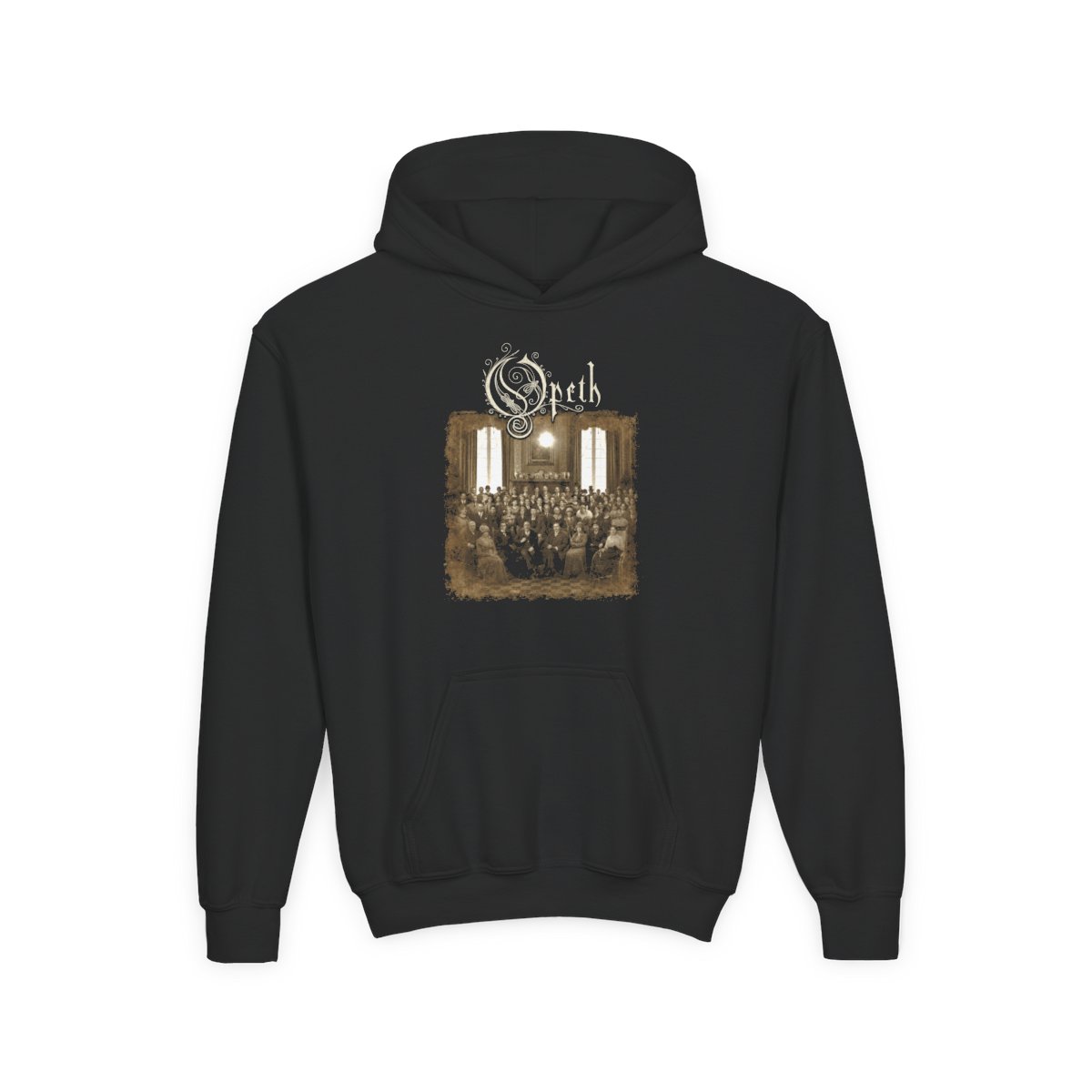
That newest album has one of their most striking pieces: the Last Will and Testament youth hoodie, with a sepia group portrait under the Opeth name on the front and five portraits on the back.
Other Opeth designs follow the albums too: hooded figures standing in still water under an orange sun for Blackwater Park, an overgrown green stone doorway for Watershed, and a serpent-branched tree under the word HERITAGE on the back of the Heritage Tree design.
Which of their pieces go with ours?
Here's the fun part. A few pairings we think work, if you like to mix your bands:
- Murky water, two ways. Our Swamp Creature design, a green creature rising from murky water, sits well beside Opeth's Blackwater Park figures standing in still water. Same mood, very different music.
- Skulls for the darker days. Our Skull design, a black skull in a cloud of stippled dots, pairs with Opeth's Skull and Candles, a skull crowned with red blooms between dripping candles.
- Colour for colour's sake. Our Psychedelic Bloom, red bubble letters in an orange flower frame, matches the warmth of Opeth's Peacock Figure, with its blue peacock and red sun.
- Quiet and gentle. Our Wavy Wordmark in purple next to Nick Cave's Ghosteen Lamb makes a soft, easy pair for someone who likes their merch understated.
- Something loud. Our Orange Ute, a giant orange in the tray of a pink ute, and Nick Cave's Dig, Lazarus, Dig!!! in yellow on red. Neither one is shy.
Where to go from here?
Put on Push the Sky Away or Heritage tonight and see where it takes you. If one of them sticks, there's a whole back catalogue waiting, and a design for nearly every era of it. And when you're ready to pair one with something from our side, our own range has all eight of our designs in one place.